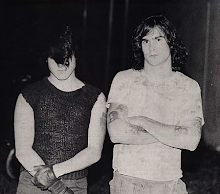
By the start of the 1980s the original punk scene had died, but music changed forever. Popular music became New Wave, a spin off of the disco, experimental and punk 70s but with synths and pop-y sound. While that was happening, a spin off of punk occurred called post-punk. A lot of post-punk music crossed with New Wave. Some was also considered to have Gothic elements like Siouxsie & the Banshees, the Cure, and Joy Division.
Examples:
http://www.allmusic.com/cg/amg.dll?p=amg&sql=77:2636
The Killing Moon by Echo & The Bunnyen
Thursday, December 10, 2009

Thursday, November 19, 2009
Punk/No Wave Lyricism
Branching out from the earlier topic of Experimental music, the focus of lyrics and writing during the 1970s and 1980s was very important to experimental music history.
Punk was a concept that began in the 70s and it's origin is very debatable, but most agree it was derived from the magazine title co-created by Legs McNeil. Much of punk's shock factor was the music, loud and fast. But another side that often goes unattended is the lyrics to the music. A lot of musicians and singers during the time were also poets and writers. Prime examples of this would be Patti Smith, Richard Hell, Tom Verlaine, etc. What these writing-focused artists were doing began the influence of a small sub-genre in NYC called "no wave."
No Wave was a New York scene considered to be a sub-genre of Experimental music. Much like punk, the music had a lot of shock factor being noisy and bizarre. The musicians were writers and poets as well who would do readings side-by-side with the punk musicians. Lydia Lunch, Thurston Moore, Glenn Branca are a few names that are well-known writers in the No Wave scene.
A movie that does a good job explaining the no wave scene: Kill Your Idols, (Review)
No Wave zine created by Glenn Branca and Barbara Ess: Just Another Asshole, (Wiki)
Richard Hell & The Voidoids performing "Blank Generation."
Here is Richard Hell's writing on punk lyrics as poetry: http://www.richardhell.com/punkpoetry.html
Punk was a concept that began in the 70s and it's origin is very debatable, but most agree it was derived from the magazine title co-created by Legs McNeil. Much of punk's shock factor was the music, loud and fast. But another side that often goes unattended is the lyrics to the music. A lot of musicians and singers during the time were also poets and writers. Prime examples of this would be Patti Smith, Richard Hell, Tom Verlaine, etc. What these writing-focused artists were doing began the influence of a small sub-genre in NYC called "no wave."
No Wave was a New York scene considered to be a sub-genre of Experimental music. Much like punk, the music had a lot of shock factor being noisy and bizarre. The musicians were writers and poets as well who would do readings side-by-side with the punk musicians. Lydia Lunch, Thurston Moore, Glenn Branca are a few names that are well-known writers in the No Wave scene.
A movie that does a good job explaining the no wave scene: Kill Your Idols, (Review)
No Wave zine created by Glenn Branca and Barbara Ess: Just Another Asshole, (Wiki)
Richard Hell & The Voidoids performing "Blank Generation."
Here is Richard Hell's writing on punk lyrics as poetry: http://www.richardhell.com/punkpoetry.html
Thursday, November 12, 2009
Experimental Rock

Sonic Youth image from "Daydream Nation" album.
This ranges from 1960s to present. Experimental rock was derived from free jazz artists like Sun Ra and avant-garde composers such as John Cage. Popular bands that turned to this genre in later times were The Beatles and The Rolling Stones.
During the 60s notable bands were The Velvet Underground, The Godz, The Fugs, Captain Beefheart and The Magic Band and The Mothers of Invention.
In the 70s when punk came around, their were many experimental sub-genres like No Wave, which include artists like James Chance and The Contortions, Glenn Branca, Lydia Lunch, and Suicide to name some.
For the 1980s experimental bands including Sonic Youth, Swans, Butthole Surfers and Dinosaur Jr. During this time hardcore punk and rap was emerging and was influencing experimental music as well.
In the 90s there were experimental lo-fi bands such as Half Japanese, Sebodah, and Guided by Voices.
Nowadays, well known experimental bands that came out after 2000 are The Are Powers, HEALTH, Deerhunter, Ponytail, and PRE.
The Velvet Underground playing "Venus In Furs" during the late 1960s.
James Chance and The Contortions performing "I Can't Stand Myself" live in the 70s.
50s Rock n' Roll
This is a beginning to the basic understanding of the history of 50s rock n roll. Many popular artists from this genre include Elvis Presley, Buddy Holly, Chuck Berry, Jerry Lee Lewis, Little Richard, Bill Haley & The Comets and more.
The sociologist Simon Frith identifies rock and roll as a hybrid music, which emerged in the American outh if the mid-1950s as a grafting of puritanical 'white' country and western lyrics on to sexually explicit 'black' blues rhythms.
Pity Peggy Sue, by Barbara Bradby and Brian Torode
Rock n' Roll... was a music-industry product, calculated purely in terms of entertainment value and based on... western swing, boogie and various rhythm and blues playing styles. The only difference was that this music was presented as a caricature of itself... Rock n' roll represented a common way of thinking and feeling on the part of a whole generation of middle-class American youth...
Rock music: a musical-aesthetic study, by Peter Wicke
Buddy Holly & The Crickets performing "Peggy Sue" in 1957.
Chuck Berry performing "Roll Over Beethoven" (unfortunately I think this specific performance is from the early 60s, hopefully I'll find a 50s version in the future.)
First Post - The Objective
Here is my research page on music genres and vocals starting from the 20th century that interests me. The theme is very broad right now but I am hoping to condense it over time.
I will be posting and writing about genres I like and genres that I discover while looking into my favorites. I want to this be have a lot of info about music I do not yet know about, and my journey into discovering new music. I have been fascinated with music history for years now but this is the first time I am writing about it and showing to the public. Hopefully it will be consistent and coherent.
To find out what I'm listening to right now: www.last.fm/user/catsonbebop/
Subscribe to:
Posts (Atom)